


- admin
- نوامبر 5, 2025
- Ankle Implant

Ankle Implant
Ankle Implants and the Necessity of Accurate Performance Evaluation The ankle joint is one of the most complex and dynamic joints in the human body, playing a crucial role in walking, balance control, and load bearing. Due to its multi-axial mobility and the transmission of both vertical and horizontal loads, severe injuries or advanced arthritis of the ankle can significantly impair an individual’s mobility. In such cases, the use of ankle implants represents one of the most effective approaches to restoring natural movement and reducing pain. However, the proper performance of these implants can only be ensured through rigorous mechanical and biomechanical testing.
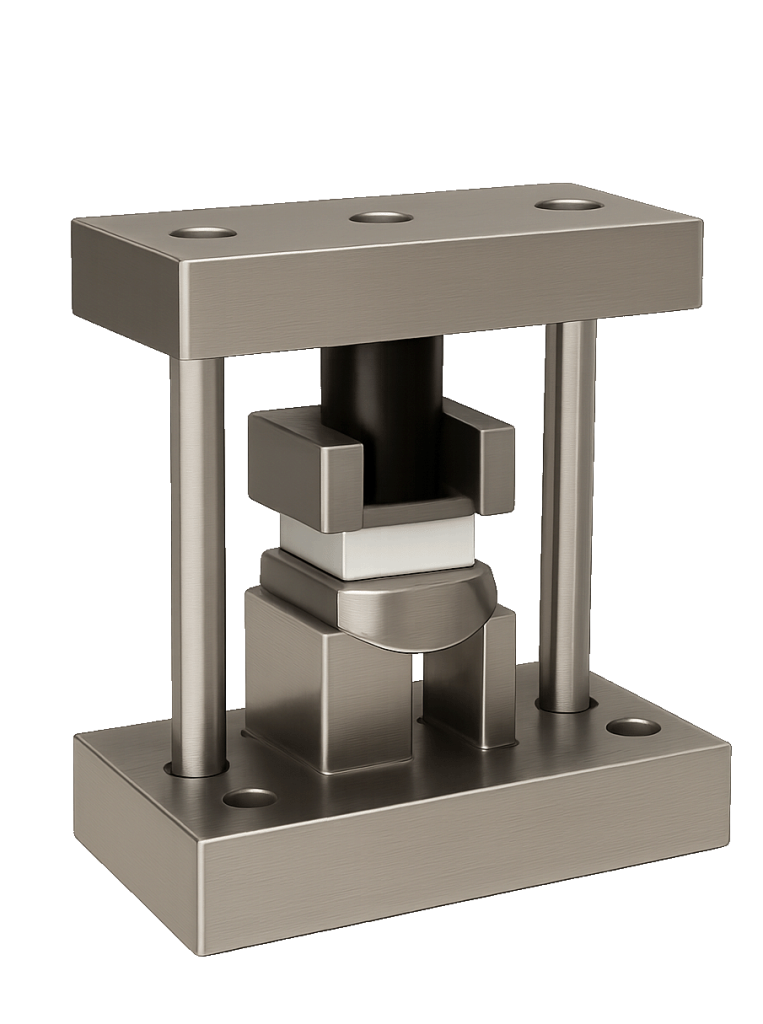
Key Tests for Ankle Implant Evaluation
To accurately analyze the performance of ankle implants, a series of specialized tests are conducted, the most important of which include:
Load Test: This test subjects the ankle implant to compressive and combined loads that simulate walking and standing conditions. The objective is to evaluate the structural resistance of the implant against deformation and failure.
Stress Test: The complex movements of the ankle joint generate localized and distributed stresses within the implant. This test evaluates the behavior of the ankle implant in response to these stresses.
Fatigue Test: Throughout its service life, the ankle joint experiences millions of movement cycles. This test evaluates whether the ankle implant can withstand these cycles without the initiation of cracks or failure.
Wear Test: The confined space of the ankle joint is highly sensitive to wear. In this test, the amount of wear particles released from the implant surface and their impact on joint performance are measured.
Range of Motion Test: This test assesses whether the ankle implant is capable of simulating and restoring the natural range of motion of the joint.
Contact Pressure Distribution Analysis: One of the most critical factors in the success of ankle implants is the proper distribution of contact pressure between components. Any imbalance in this distribution may lead to premature wear and a reduced joint lifespan.
Why Is Ankle Implant Testing Necessary?
Unlike many orthopedic implants, ankle implants must operate within a confined space while being subjected to very high loads. During a typical day, the ankle joint experiences thousands of cycles of motion and loading.
If an ankle implant is unable to withstand these loads, there is a risk of failure, loosening, surface wear, and impaired joint function.
The primary movements of the ankle joint include dorsiflexion, plantarflexion, inversion, and eversion. Each of these movements applies a distinct pattern of pressure and stress to the implant. Therefore, ankle-related tests must be multi-axial, cyclic, and based on realistic physiological conditions in order to properly evaluate the behavior of ankle implants.
Standards for the Evaluation of Ankle Implants
One of the recognized standards for the evaluation of ankle implants is the international standard ASTM F2665. This standard introduces a set of test methods that include the assessment of structural strength, fatigue resistance, wear performance, and the ability to restore the natural motion of the ankle joint.
This standard has been developed in consideration of the specific characteristics of the ankle joint and clearly defines the levels of compressive, shear, and torsional loading under which the implant must be tested. Evaluation of ankle implants in accordance with this standard enables the prediction of long-term performance and mechanical durability under realistic physiological conditions.
Conclusion
Due to complex loading conditions and its critical role in movement, the ankle joint requires precise evaluation of its replacement implants. Mechanical, kinematic, and wear tests, based on standards such as ASTM F2665, enable accurate prediction of ankle implant performance under realistic physiological conditions. The more precise and specialized these tests are, the higher the likelihood of clinical success of ankle implants and the lower the risk of failure or secondary complications.







 Persian
  English
  Arabic