


Orthopedic Implant Testing and Evaluation
Medical device testing is considered one of the fundamental pillars in ensuring the safety, performance, and regulatory compliance of medical products. Given the complexity of medical device design and operating conditions—particularly in the field of orthopedics—conducting precise mechanical and functional tests plays a critical role in reducing clinical risks and enhancing product reliability. Orthopedic devices are in direct contact with the musculoskeletal system of the human body and must be capable of withstanding complex mechanical loads, repetitive motions, and long-term usage conditions.
The scope of medical device testing encompasses nearly all types of medical products. These tests include orthopedic, dental, vascular implants, and spinal systems, with specialized evaluation methods defined for each product category in accordance with its clinical application. In the field of orthopedics, particular emphasis is placed on assessing mechanical behavior, functional durability, fatigue resistance, and long-term stability of implants, as these factors directly influence treatment success and the patient’s quality of life.
Medical device testing covers all stages of product development, from early design and preclinical phases to the final stages of supporting regulatory submissions and obtaining legal approvals. In many cases, standardized test methods alone are not sufficient to address the requirements of innovative orthopedic designs. Therefore, the development of dedicated test methods and customized protocols based on reference standards plays a critical role in achieving a more accurate evaluation of orthopedic implant performance.
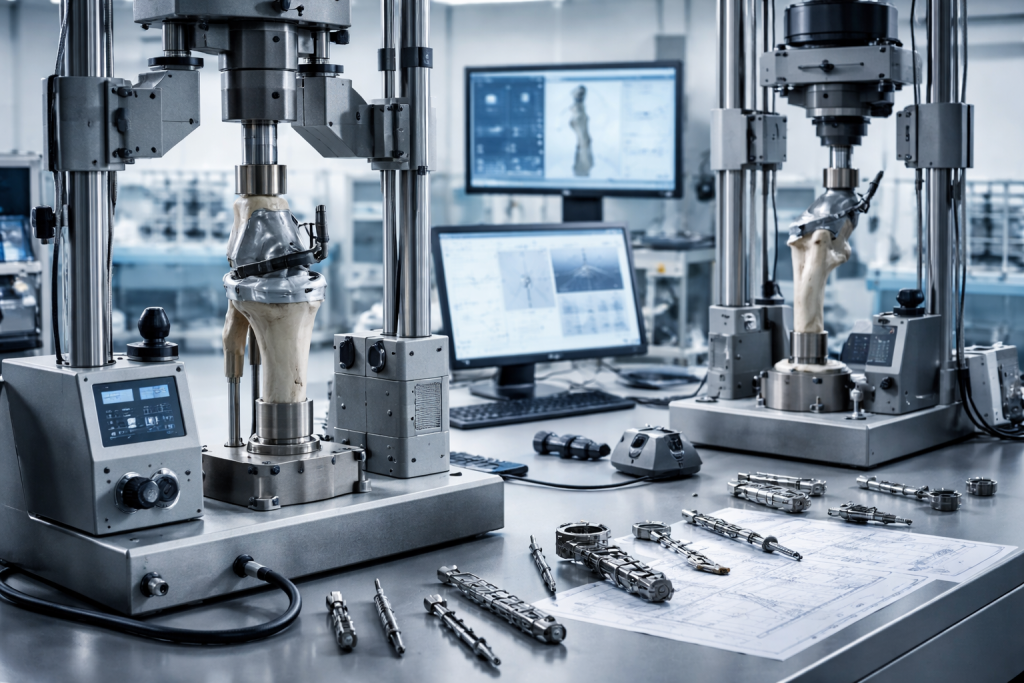
The scope of medical device testing covers nearly all types of medical products. These tests include orthopedic, dental, vascular, and spinal implants, with specialized evaluation methods defined for each product group in accordance with its clinical application. In the field of orthopedics, particular emphasis is placed on assessing mechanical performance, durability, fatigue behavior, and the long-term behavior of implants.
Medical device testing covers all stages of product development, from early preclinical phases to the final stages of supporting regulatory submissions and obtaining legal approvals. In many cases, standard test methods alone are not sufficient to meet the requirements of innovative orthopedic designs. Therefore, the development of dedicated test methods and customized protocols plays a critical role in achieving a more accurate evaluation of implant performance.
Biomechanical and Fatigue Testing in Orthopedics
Biomechanical and fatigue testing is considered one of the most critical components in the evaluation of orthopedic implants. These tests simulate physiological conditions of the human body to assess implant behavior under static and dynamic loading. Implants used in the hip, knee, shoulder, and small joints must withstand millions of repetitive loading cycles. The analysis of long-term durability, deformation, stress concentration, and fatigue behavior plays a key role in predicting clinical performance and the service life of orthopedic implants.
Wear Testing of Orthopedic Implants
Wear is considered one of the primary causes of functional failure in orthopedic joint implants. Wear testing, performed using advanced multi-station simulators, evaluates material wear behavior under simulated motion and loading conditions. Analysis of wear patterns, material loss rates, and the amount of generated wear debris provides valuable insights into the long-term performance of orthopedic implants and plays a significant role in design optimization and material selection.
Corrosion and Fretting Corrosion Testing
In orthopedic implants, particularly in modular designs, corrosion and fretting corrosion are considered significant challenges. Specialized corrosion testing evaluates the resistance of metallic materials and junctions under simulated physiological environments. These tests are essential for assessing chemical stability, reducing the risk of ion release, and ensuring the long-term safety of orthopedic implants.
Materials and Coatings Testing
The evaluation of material properties is one of the fundamental pillars of medical device testing in the field of orthopedics. Static and dynamic mechanical tests—including compression, tensile, and shear testing—together with the analysis of coatings and surface layers, provide detailed insights into material behavior under clinical conditions. These tests play a critical role in selecting appropriate materials, improving coating adhesion, and enhancing the durability of orthopedic implants.
Particle and Ion Release Testing
In orthopedic implants, particularly modular designs, the assessment of particle and ion release is of critical importance. Particle and ion release testing helps evaluate the biological safety of materials in contact with body tissues and plays a significant role in analyzing potential inflammatory and clinical risks.
Overall, medical device testing with a focus on orthopedics is recognized as a key process in the development of safe, durable, and reliable implants. These tests create a bridge between engineering design, international standard requirements, and clinical performance, and play a fundamental role in improving treatment quality, enhancing patient safety, and advancing clinical outcomes in the field of orthopedics.
 Persian
  English
  Arabic