


- admin
- نوامبر 5, 2025
- General Microbiological Tests
Bacterial Endotoxins Test (BET)
A Comprehensive Guide to Endotoxin Control in Pharmaceutical Products and Medical Devices
The Bacterial Endotoxins Test (BET) is one of the most critical quality control tests in the pharmaceutical and medical device industries. The purpose of this test is to ensure the absence or controlled level of bacterial endotoxins in the final product—substances that can cause severe and sometimes fatal reactions in the human body even at extremely low concentrations. For this reason, endotoxin testing is a legal and scientific requirement for injectable products, implantable devices, and medical devices that come into contact with blood or cerebrospinal fluid (CSF).
What Are Endotoxins and Why Are They Dangerous
Endotoxins are lipopolysaccharide (LPS) components of the cell wall of Gram-negative bacteria. These compounds remain biologically active even after bacterial death and, unlike microorganisms, are not easily eliminated by conventional sterilization methods. Entry of endotoxins into the body can lead to fever, severe inflammation, endotoxin shock, and sepsis. Therefore, endotoxin testing is recognized as a primary indicator of biological safety for high-risk products.
Standards and Regulatory References for Endotoxin Testing
In the pharmaceutical field, endotoxin testing is conducted in accordance with recognized pharmacopoeias. The most important references include USP and the European Pharmacopoeia, section 2.6.14. The rabbit pyrogen test, once widely used, is now permitted only under specific circumstances, with the preferred approach being BET methods based on LAL or validated non-animal alternatives.
In the medical device sector, ANSI/AAMI ST72 serves as the primary reference for endotoxin test design, extraction conditions, routine monitoring, and reporting. Endotoxin requirements are also addressed within the biocompatibility framework of ISO 10993.
Endotoxin Limits
Acceptable endotoxin limits depend on the product type and its route of contact with the body. For non-intrathecal injectable products, the limit is calculated based on the maximum patient dose. For products intended for intrathecal use or direct contact with cerebrospinal fluid, much stricter limits apply.
In medical devices, endotoxin limits are typically expressed as the allowable amount per device. Devices that contact blood or lymph have higher allowable limits compared to those contacting CSF. The selection of reporting units (EU/mL or EU/device) depends on the nature of the product.
Methods for Endotoxin Testing
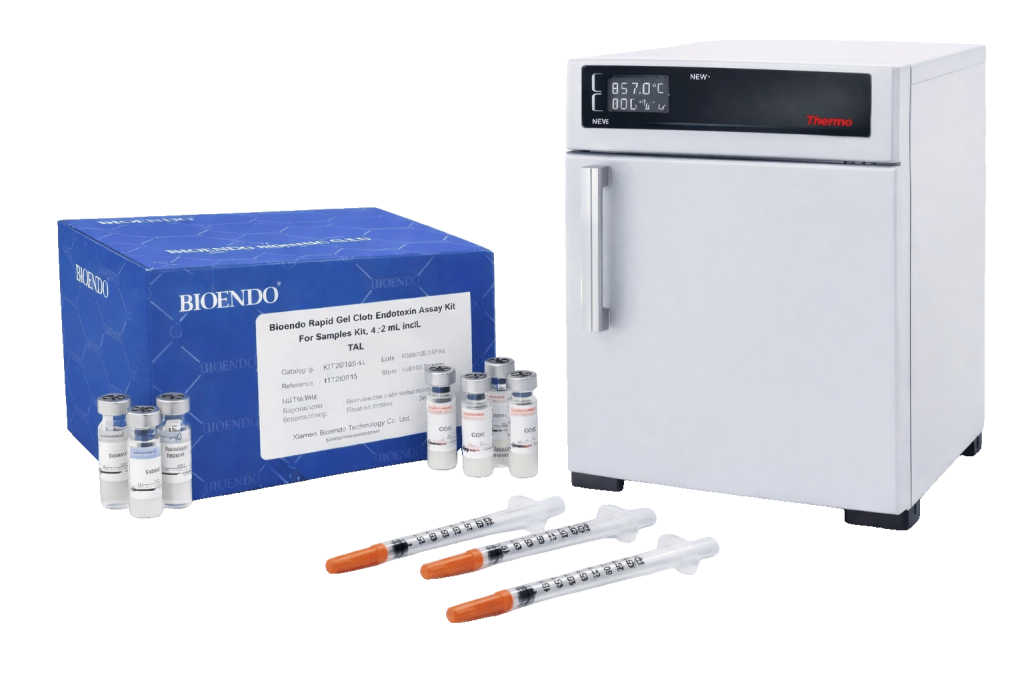
Several methods are available for endotoxin testing. The Gel-Clot method is a qualitative test that indicates the presence or absence of endotoxin and is commonly used for screening or routine batch release. Quantitative methods such as Kinetic Turbidimetric and Kinetic Chromogenic assays allow precise measurement of endotoxin levels and are widely used in reference laboratories.
The recombinant Factor C (rFC) method, based on recombinant technology, is recognized as a non-animal alternative to the LAL test. Use of this method requires appropriate method validation and demonstrated equivalence in accordance with pharmacopoeial requirements.
Sample Preparation and Extraction
Proper sample preparation is critical in endotoxin testing. Pharmaceutical products are typically diluted using pyrogen-free water. For medical devices and implants, endotoxins are extracted from the product surface, and the resulting extract is tested. All containers, tools, and tubes must be depyrogenated to prevent secondary contamination.
Method Validation and Interference Control
Before routine endotoxin testing, the suitability of the method for the specific product matrix must be demonstrated. This includes evaluation of potential interference with the test reaction. Adequate recovery of the endotoxin standard in the presence of the sample confirms the validity of the test results.
Reporting and Quality Control
An endotoxin test report should include the test method, test conditions, final sample dilution, positive and negative control results, and comparison with acceptance criteria. Continuous monitoring of process water, working environment, and product-contacting equipment plays a key role in preventing endotoxin contamination.
Conclusion
Endotoxin testing is one of the fundamental pillars of safety assurance for pharmaceutical products and medical devices. Proper execution of the test, method validation, and control of contamination sources reflect the maturity of the quality system and compliance with international standards. The informed use of advanced methods such as rFC represents an effective step toward improved quality and reduced reliance on animal-based testing.






 Persian
  English
  Arabic