
Cleanroom microbial testing is a strategic requirement in pharmaceutical and medical industries, not a ceremonial activity. Accurate, routine, and well-documented execution of these tests simultaneously ensures product quality, patient safety, and manufacturer credibility.

- Home
- About Us
- Contact Us
- Submit Request
- Tests
- Biocompatibility Testing
- Ethylene Oxide Residuals Testing
- General – Microbiological Tests
- Atomic Absorption Testing
- Accelerated Stability Testing
- Specialized Medical Device Testing
- Analytical Testing
- Packaging Tests
- Catalog
- Laboratory
- Specialized Microbiological Testing
- Antimicrobial Performance Evaluation
- Molecular Testing
- Heavy Metals Testing
- Orthopedic Testing
- Home
- About Us
- Contact Us
- Submit Request
- Tests
- Biocompatibility Testing
- Ethylene Oxide Residuals Testing
- General – Microbiological Tests
- Atomic Absorption Testing
- Accelerated Stability Testing
- Specialized Medical Device Testing
- Analytical Testing
- Packaging Tests
- Catalog
- Laboratory
- Specialized Microbiological Testing
- Antimicrobial Performance Evaluation
- Molecular Testing
- Heavy Metals Testing
- Orthopedic Testing

- Home
- About Us
- Contact Us
- Submit Request
- Tests
- Biocompatibility Testing
- Ethylene Oxide Residuals Testing
- General – Microbiological Tests
- Atomic Absorption Testing
- Accelerated Stability Testing
- Specialized Medical Device Testing
- Analytical Testing
- Packaging Tests
- Catalog
- Laboratory
- Specialized Microbiological Testing
- Antimicrobial Performance Evaluation
- Molecular Testing
- Heavy Metals Testing
- Orthopedic Testing
Definition of Cleanroom Microbial Testing
Cleanroom microbial testing is a critical component of Environmental Monitoring programs and plays a direct role in ensuring the quality of sterile products, pharmaceuticals, and medical devices. These tests are designed and implemented in accordance with the requirements of ISO 14644, ISO 14698, and EU GMP Annex 1.
Cleanroom microbial testing is a critical component of Environmental Monitoring programs and plays a direct role in ensuring the quality of sterile products, pharmaceuticals, and medical devices. These tests are designed and implemented in accordance with the requirements of ISO 14644, ISO 14698, and EU GMP Annex 1.
Purpose of Cleanroom Microbial Testing
The primary objective of cleanroom microbial testing is to ensure the maintenance of stable hygienic conditions and to prevent product contamination throughout the manufacturing process. These tests enable manufacturers to:
- Determine the actual level of microbial contamination in the environment
- Evaluate the effectiveness of HVAC systems and HEPA filters
- Monitor the performance of cleaning and disinfection procedures
- Reduce the risk of product contamination and recalls
- Maintain full compliance with regulatory authority requirements
In simple terms, cleanroom microbial testing is a preventive tool, not merely a documentation requirement.
Steps of Cleanroom Microbial Testing
1. Sampling
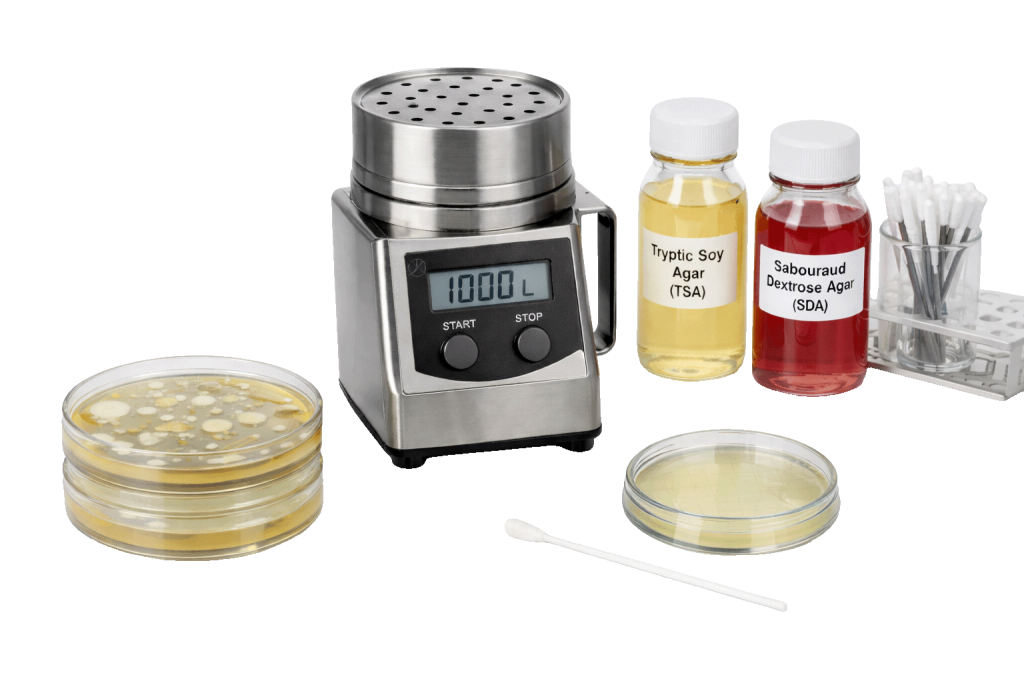
The first step in cleanroom microbial testing is targeted sampling from potential contamination sources. These sources include air, work surfaces, equipment, walls, floors, and personnel garments or gloves. Common sampling methods include:
- Settle Plates (Passive Sampling): Placement of 90 mm agar plates at designated cleanroom locations for 4 hours to collect settling airborne microorganisms.
- Contact Plates: Direct contact of 55 mm agar plates with surfaces, equipment, or operator gloves to assess surface contamination.
- Active Air Sampling: Drawing a defined volume of air (typically 1 cubic meter) using an air sampler, allowing airborne microorganisms to impact directly onto a culture medium.
The selection of sampling methods depends on the cleanroom grade, process criticality, and identified critical control points.
2. Microbial Cultivation
After sampling, plates are incubated on standard culture media. The most commonly used media include Tryptic Soy Agar (TSA) for bacterial growth and Sabouraud Dextrose Agar (SDA) for fungal and mold growth. This step enables the detection of viable microorganisms.
Incubation
Incubation is typically performed in two stages to cover a broad spectrum of microorganisms:
- 30–35°C for mesophilic bacteria
- 20–25°C for fungi and molds
The incubation period usually ranges from 5 to 7 days, depending on the applicable standard.
4. Colony Counting
After incubation, the grown colonies are counted. Cleanroom microbial testing results are reported as CFU (Colony Forming Units) per air volume, surface area, or plate. These data form the basis for assessing environmental hygiene status.
5. Data Analysis and Corrective Actions
The obtained results are compared with acceptance limits defined in EU GMP Annex 1. If out-of-specification (OOS) results are observed, corrective actions such as source investigation, increased cleaning frequency, personnel behavior review, airflow reassessment, and test repetition are implemented.
Frequency of Cleanroom Microbial Testing
Acceptable microbial limits vary depending on the cleanroom classification and are generally defined as follows:
- Grade A (ISO 5): Practically free of detectable contamination
- Grade B: Grade B: Very low and tightly controlled levels
- Grade C and D: Higher limits appropriate to process nature
These limits may be redefined based on risk assessment and internal GMP policies.
Importance of Cleanroom Microbial Testing
The testing frequency should correspond to the cleanroom grade:
- Grade A and B: Daily or before each production shift
- Grade C: Weekly
- Grade D: Monthly or quarterly
Increased testing frequency is recommended following process changes, maintenance activities, or contamination events.
Importance of Cleanroom Microbial Testing
Cleanroom microbial testing ensures product quality, safety, and manufacturing stability. These tests serve as the first line of defense against invisible contamination and play a key role in preventing financial losses, production downtime, and regulatory risks.
 Persian
  English
  Arabic