
- Home
- About Us
- Contact Us
- Submit Request
- Tests
- Biocompatibility Testing
- Ethylene Oxide Residuals Testing
- General – Microbiological Tests
- Atomic Absorption Testing
- Accelerated Stability Testing
- Specialized Medical Device Testing
- Analytical Testing
- Packaging Tests
- Catalog
- Laboratory
- Specialized Microbiological Testing
- Antimicrobial Performance Evaluation
- Molecular Testing
- Heavy Metals Testing
- Orthopedic Testing
- Home
- About Us
- Contact Us
- Submit Request
- Tests
- Biocompatibility Testing
- Ethylene Oxide Residuals Testing
- General – Microbiological Tests
- Atomic Absorption Testing
- Accelerated Stability Testing
- Specialized Medical Device Testing
- Analytical Testing
- Packaging Tests
- Catalog
- Laboratory
- Specialized Microbiological Testing
- Antimicrobial Performance Evaluation
- Molecular Testing
- Heavy Metals Testing
- Orthopedic Testing


- Home
- About Us
- Contact Us
- Submit Request
- Tests
- Biocompatibility Testing
- Ethylene Oxide Residuals Testing
- General – Microbiological Tests
- Atomic Absorption Testing
- Accelerated Stability Testing
- Specialized Medical Device Testing
- Analytical Testing
- Packaging Tests
- Catalog
- Laboratory
- Specialized Microbiological Testing
- Antimicrobial Performance Evaluation
- Molecular Testing
- Heavy Metals Testing
- Orthopedic Testing
Bioburden Testing of Medical Devices
What Is Bioburden
Bioburden refers to the total number of viable microorganisms, including bacteria, yeasts, and molds, present on the surface or within a non-sterile product prior to sterilization. This microbial contamination may originate from raw materials, manufacturing processes, human handling, cleanroom environments, or packaging and transportation activities.
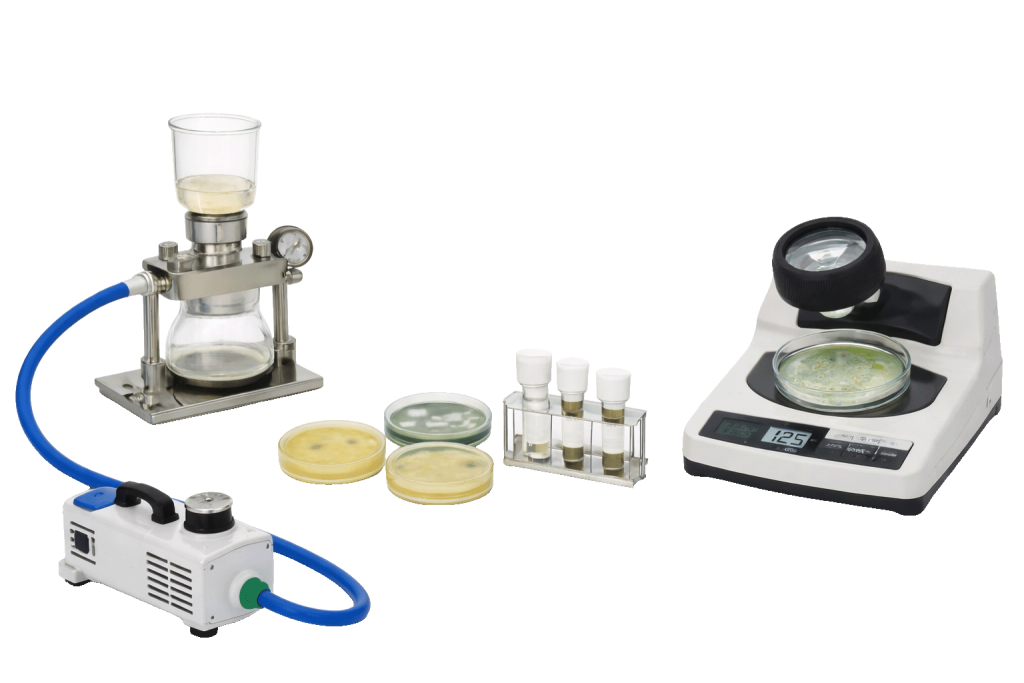
Bioburden testing is one of the most critical microbiological tests in the medical device and pharmaceutical industries and is performed to quantify this microbial load. The results provide the scientific and technical basis for designing, selecting, and validating sterilization processes and play a direct role in ensuring patient safety. Bioburden results are reported as colony forming units (CFU) per unit of product, such as CFU/device, CFU/mL, CFU/g, or CFU/cm².
Why Is Bioburden Testing Critically Important
The importance of bioburden testing extends beyond simple microbial enumeration. This test:
- Provides the scientific basis for defining sterilization parameters
- Plays a key role in achieving a Sterility Assurance Level (SAL = 10⁻⁶)
- Serves as a primary tool for microbiological quality control in manufacturing
- Is required for regulatory approvals and CE marking
- Is directly reviewed during ISO 13485, GMP, and ISO 17025 audits
Without reliable bioburden data, no sterilization process can be scientifically or regulatorily justified.
Objectives of Bioburden Testing
Bioburden testing is conducted to:
- Determine the true level of microbial contamination prior to sterilization
- Evaluate the effectiveness of cleaning, washing, and disinfection processes
- Monitor microbial contamination throughout manufacturing stages
- Identify critical contamination points within the production line
- Provide input data for sterilization validation using EO, gamma radiation, or steam
- Reduce the risk of post-sterilization contamination
Reference Standards for Bioburden Testing
Bioburden testing is performed in accordance with internationally recognized standards, including:
- ISO 11737-1: Determination of microbial population on medical devices prior to sterilization
- “USP and EP 2.6.12: Microbial Enumeration Tests”
Direct linkage to sterilization standards such as:
- ISO 11135 (Ethylene Oxide)
- ISO 11137 (Radiation Sterilization)
Bioburden testing must be fully compliant with these standards and traceable.
Microbiological Indicators in Bioburden Testing
In bioburden testing, two primary indicators are typically evaluated
TAMC – Total Aerobic Microbial Count
This indicator represents the total number of aerobic mesophilic bacteria, which is measured using Tryptic Soy Agar (TSA) culture medium.
TYMC – Total Yeast and Mold Count
This indicator represents the number of yeasts and molds and is typically measured using Sabouraud Dextrose Agar (SDA) culture medium. Sabouraud Dextrose Agar (SDA) اندازهگیری میشود.
Where required, additional tests such as anaerobic counts or identification of predominant microorganisms may be performed.
Bioburden Test Methods
Membrane Filtration Method:
One of the most accurate and widely used methods, particularly for liquid products or extractable samples. Microorganisms are captured on membranes with pore sizes ≤0.45 µm, then cultured and enumerated.
Direct Plating Method (Plate Count):
Used for solid or non-filterable products and includes Spread Plate and Pour Plate techniques.
Factors Affecting Bioburden Levels
Bioburden levels may be influenced by:
- Quality of raw materials and suppliers
- Personnel hygiene practices
- Equipment cleaning and maintenance status
- Cleanroom classification and environmental conditions
- Packaging, storage, and transportation processes
Controlling these factors is essential to reduce bioburden and ensure sterilization process stability.
Role of Bioburden Testing in Quality Control
Bioburden testing enables manufacturers to:
- Assess manufacturing process consistency
- Detect unwanted changes in contamination levels
- Implement effective corrective and preventive actions (CAPA)
- Minimize patient safety risks
Final Summary
بایوبردن Bioburden is a critical indicator for assessing the microbiological status of medical devices prior to sterilization. Accurate and standard-compliant bioburden testing is not only a regulatory requirement but also an integral part of a professional, reliable, and patient-safety–focused quality management system.
 Persian
  English
  Arabic